|
One day, you're looking at someone you know intimately, perhaps a family member or close friend, when you sense something ... off about them.
 |
Outwardly, they appear unchanged, right down to the tinest mole and personal memory. But you know ... you know ... something's awry. You try to convince others of what you know, but they simply shrug it off. Too much psychological stress, perhaps. But after a while, even they begin to get a whiff of your paranoia, as others begin to describe similar feelings of their loved ones. But only for a few days. Soon, even those who initially felt as you do begin recanting their previous stories, assuring you that everything's fine now, showing as little emotion as your own friends and family ... or, at least, the now-hollow shells that used to contain them. And the horror contained within ... ?
When novelist Jack Finney first published his science fiction tale "The Body Snatchers" in serialized form in Collier Magazine in 1954, he had no idea of how his eerie concept of creeping conformism would galvanize readers. Soon, future Dirty Harry director Don Siegel brought it to the screen as the 1956 classic Invasion Of The Body Snatchers, which revealed the source of those emotionless drones as microscopic spores, drifting down from outer space and swelling into huge "seed pods" that quickly assumed the forms of human beings before disposing of the originals. It was a tight, scary B-picture that became more than that in the eyes of many who viewed it as an ingenious metaphor 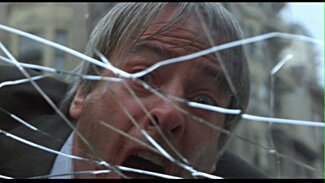 for the Red Menace and/or the rise of 50's McCarthyism, those Pod People representing, perhaps, the rise of Communism. for the Red Menace and/or the rise of 50's McCarthyism, those Pod People representing, perhaps, the rise of Communism.
When, 22 years later, director Philip Kaufman (The Right Stuff) got the rights to the story, he and screenwriter W.D. Richter took the narrative out of it's small, rural town setting and plunked it down in the midst of the "Me Decade", late-70's San Francisco, with health department inspector Matthew Bennell (Donald Sutherland) witness to a curious psychological phenomena sweeping the city, wherin people are starting to question weither their friends and loved ones are still who they are. Amongst the inflicted is Matthew's fellow health department employee Elizabeth Driscoll (the lovely Brooke Adams), who's adamant that her dentist 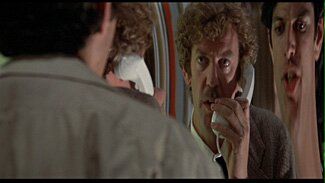 boyfriend (Art Hindle) has...changed somehow. Cold. Distant. Bland. Matthew convinces the increasingly distraught Elizabeth to talk with his pshyciatrist friend. Dr. David Kibner (Mr. Spock himself, Leonard Nimoy, in an inspired bit of casting), who is himself puzzled by the plague of paranoia he's been witness to over the past few days. But when Matthew's friend Jack Bellicec (a young, skinny Jeff Goldblum, in an early film role), and his wife Nancy (Veronica Cartwright) find what appears to be a half-formed "body" in their mud bath back room, suddenly it becomes clear that there's a kernel of truth at the heart of the current epidemic of distrust. boyfriend (Art Hindle) has...changed somehow. Cold. Distant. Bland. Matthew convinces the increasingly distraught Elizabeth to talk with his pshyciatrist friend. Dr. David Kibner (Mr. Spock himself, Leonard Nimoy, in an inspired bit of casting), who is himself puzzled by the plague of paranoia he's been witness to over the past few days. But when Matthew's friend Jack Bellicec (a young, skinny Jeff Goldblum, in an early film role), and his wife Nancy (Veronica Cartwright) find what appears to be a half-formed "body" in their mud bath back room, suddenly it becomes clear that there's a kernel of truth at the heart of the current epidemic of distrust.
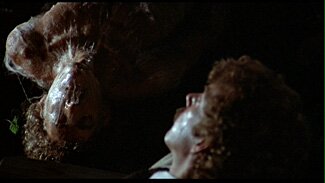
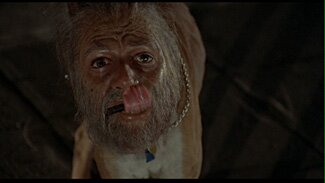
Kaufman's take on the material is masterful, evoking a low-grade uneasiness from practically the film's first frames (with a depiction of the space spores drifting down on the unsuspecting city) that he increases with slow, methodical precision as the story progresses. Watching the film a second time, one catches many of the signposts of the slow spread of the alien infestation practically as 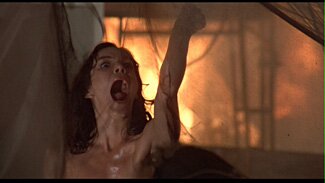 subliminal background action (a businessman running down the street, an uncredited Robert Duvall as a priest on a swing set). By the time the aliens have reached such a critical mass that they no longer have to conceal themselves, now openly hunting down the last few pockets of humanity, the film has escalated into outright terror, and as our increasingly desperate band of heroes try to figure out a way to escape the plague of emotionless space zombies, we share their fatigue, their determination, their attempts to walk amongst the Pod People without drawing attention to themselves, until Kaufman pulls the rug out from the audience with an unforgettably terrifying final sequence, the final human standing having their last hopes dashed via an inhuman shriek. subliminal background action (a businessman running down the street, an uncredited Robert Duvall as a priest on a swing set). By the time the aliens have reached such a critical mass that they no longer have to conceal themselves, now openly hunting down the last few pockets of humanity, the film has escalated into outright terror, and as our increasingly desperate band of heroes try to figure out a way to escape the plague of emotionless space zombies, we share their fatigue, their determination, their attempts to walk amongst the Pod People without drawing attention to themselves, until Kaufman pulls the rug out from the audience with an unforgettably terrifying final sequence, the final human standing having their last hopes dashed via an inhuman shriek.
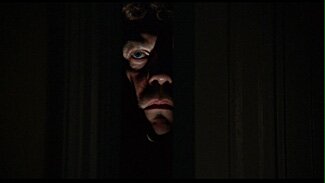 When Kaufman's Invasion Of The Body Snatchers first came out, remakes were not as frequent as they have become over the past decade. In fact, it inspired a slew of other elaborate remakes of 50's sci-fi/horror favorites throughout the 80's, like John Carpenter's The Thing, David Cronenberg's The Fly, and Chuck Russell's The Blob, not to mention two additional screen versions of Jack Finney's novel, Abel Ferrera's little-seen 1994 version Body Snatchers (which cribbed many iconic elements from Kaufman's version, such as the predominance of garbage trucks and some of the sound design), and the long-delayed, heavilly-reshot The Invasion, which is finally seeing the light of day this month. The jury is still out on that version (featuring Nicole Kidman, Daniel Craig...and '78 Body Snatchers co-star Veronica Cartwright), yet I doubt it'll be able to match Kaufman's haunting film, which stands as one of the finest remakes ever made. When Kaufman's Invasion Of The Body Snatchers first came out, remakes were not as frequent as they have become over the past decade. In fact, it inspired a slew of other elaborate remakes of 50's sci-fi/horror favorites throughout the 80's, like John Carpenter's The Thing, David Cronenberg's The Fly, and Chuck Russell's The Blob, not to mention two additional screen versions of Jack Finney's novel, Abel Ferrera's little-seen 1994 version Body Snatchers (which cribbed many iconic elements from Kaufman's version, such as the predominance of garbage trucks and some of the sound design), and the long-delayed, heavilly-reshot The Invasion, which is finally seeing the light of day this month. The jury is still out on that version (featuring Nicole Kidman, Daniel Craig...and '78 Body Snatchers co-star Veronica Cartwright), yet I doubt it'll be able to match Kaufman's haunting film, which stands as one of the finest remakes ever made.
 Presentation Presentation
This new edition of the film offers up a spiffy new anamorphic widescreen transfer that puts the ancient laserdisc transfer utilized for MGM's previous DVD to shame. There's still a light haze of grain visible in many of the darker shots, but otherwise, the Pod People have never looked better. The 2.0 stereo soundtrack (with additional options in French and Spanish) does an excellent job in mixing the film's elaborate soundtrack (dscussed below) with Denny Zeitlin's nightmarishly bizarre score, an amalgam of minor key jazz harmonies, atonal string parts, unusual percussion effects and throbbing electronic bass lines that absolutely pulsates with dread.
 Extras Extras
The first disc of this set offers a full-length audio commentary with director Philip Kaufman (reprised from the original DVD release), which offers an intelligent discussion of the film's underlying themes, the low-budget special effects (detailed below), his aborted attempt to make a Star Trek movie in the late 70's, and pointing out numerous cameos, including the 1956 film's star, Kevin McCarthy (as a terrified man pounding on the hood of Sutherland's car and frantically warning him "They're coming! You're next!"), and director, Don Siegel (as a sinister cabbie who calls in that he's carrying a pair of "Type H" passengers). This is a fine track that fans of the film will enjoy a great deal, even if Kaufman leaves a few dead spots here and there. Disc two offers a series of four featurettes (or "pods") about the film's production, including...
 - Re-Visitors From Outer Space or How I Learned How To Stop Worrying And Love The Pod (16:15), sporting newly-conducted interviews with Kaufman, Donald Sutherland, Veronica Cartwight, and others discussing the film's relationship to the 50's original, it's satire of the 70's San Franciso scene, and it's eventual release and cmmercial and critical success. One wishes it were longer and featured input from the other major cast members, but this is a fairly enjoyable look back. - Re-Visitors From Outer Space or How I Learned How To Stop Worrying And Love The Pod (16:15), sporting newly-conducted interviews with Kaufman, Donald Sutherland, Veronica Cartwight, and others discussing the film's relationship to the 50's original, it's satire of the 70's San Franciso scene, and it's eventual release and cmmercial and critical success. One wishes it were longer and featured input from the other major cast members, but this is a fairly enjoyable look back.
- Practical Magic: The Special Effects Pod (4:40) is a disappointingly brief look at the ingenious techniques Kaufman and his F/X supervisors used to realize the film's prologue depicting the pods leaving the dessicated surface of their homeworld and drifting through space towards Earth (including a $5 jar of paint thinner dipped into water). It's always a treat to see how movies achieved special effects in a pre-digital age.
 - The Man Behind The Scream: The Sound Effects Pod (12:48) is the best of the four featurettes, featuring an interview with sound designer Ben Burtt (at the time hot off the success of his innovative work on Star Wars) talking about the many organic sounds he collected into a nightmarish sonic collage to depict the sounds of the pods "birthing" the cloned human doppelgangers, including recordings of his own wife's pregnant belly! Of course, much discussion is given to the film's most famous sound effect, the ghastly scream emited by the Pod People when they sight an unaltered human, which consisted mainly of a pig's squeal played backwards. - The Man Behind The Scream: The Sound Effects Pod (12:48) is the best of the four featurettes, featuring an interview with sound designer Ben Burtt (at the time hot off the success of his innovative work on Star Wars) talking about the many organic sounds he collected into a nightmarish sonic collage to depict the sounds of the pods "birthing" the cloned human doppelgangers, including recordings of his own wife's pregnant belly! Of course, much discussion is given to the film's most famous sound effect, the ghastly scream emited by the Pod People when they sight an unaltered human, which consisted mainly of a pig's squeal played backwards.
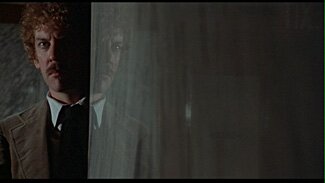
- The Invasion Will Be Televised: The Cinematography Pod (5:25) features a sit down with cinematographer Michael Chapman, who talks about researching 40's film noir thrillers in order to give the film's naturally-skewed San Francisco locations an extra dolop of uneasiness, with atmospheric use of light and shadow and Dutch camera angles.
Rounding off the disc is the film's effective theatrical trailer (2:15) in non-anamorphic 1:85.
Bottom Line
While each version of Jack Finney's endlessly maleable source material has it's own merits, Philip Kaufman's 1978 version is the most intelligent and downright scary of the bunch, full of bravura filmmaking, compelingly rattled performances and fiendish wit (it's no coincidence that the end of the "flower power" generation would come from extraterrestial plants). Just remember...they get you when you sleep.
|